
Leadership
Assessment of Worldview (LAW™)
Cavanaugh Leahy & Company
Leadership Assessment of Worldview (LAW™)
ã 2000
Cavanaugh Leahy & Company, Ltd.
Princeton Pike Corporate Center
993 Lenox Drive, Suite 200
Lawrenceville, NJ 08648
609-844-7615
The LAW™ assessment was created by T. J. Elliott, M.S., and Martin J. Leahy, Ph.D. , is based on Dr. Leahy's Model for Company™, and supported by their collaborative research on leadership. Their collaborative research involves investigations and writing based on the academic and business literatures on leadership and research in action with real leadership groups within diverse organizations.
The Model for Company™ is an eclectic product with a diverse set of sources. Its primary scholarly roots are in Gibson Burrell and Gareth Morgan's (1979) research on Sociological Paradigms and Organizational Analysis and the "paradigm wars" that followed in organization science. That body of knowledge was supplemented by the work of researchers in many disciplines, among them: Chris Argyris, David Bohm, Jean Baker Miller, Martin Buber, Mary Parker Follett, Paulo Freire, Carl Jung, Thomas Kuhn, Abraham Maslow, Carl Rogers, Donald Schön, and Ken Wilber. Leadership and OD practitioners interested in the theory behind this model should request the accompanying monograph from the Theory-In-Practice series.
How can I be a great leader in this company?
That depends on how you [should?] answer these questions: What is a company? Why bother to create one?
ne hundred years of research on leadership and we still ask: What does it take to be a great leader? Favorite places to look for answers have been: the right individual competencies, psychological profile, style, traits, habits, and now, if evolutionary psychologists have their way, it will be the right genetic make up since, for them, leaders are born not made. All of those answers have one thing in common, the belief that the answers are within the individual. This is hardly surprising. The US is a very individualistic culture. Plus, psychology has dominated leadership research for most of the last hundred years. Our search has been restricted by our culture and our tools; we've been looking for answers based on what we know how to do, one way of looking.
Recently, teams have become the rage. Teams are everywhere, even in places where teaming makes no sense given the task or situation. So, there is a big swing to the other extreme from the individual to the group, from the individualism to the collectivism. The answers now are in the ideal group. We, Americans, don't like being lumped into groups; we are uncomfortable with collectives. Plus, trying to create an ideal group is about as abstract as trying to be the exemplary individual.
The choices seem to be either focusing on the individuals, the parts of a company, or the group, that is the whole company. But what about some other way of looking that accounts for the individuals, the group, and what actually happens between actual people. Here we are suggesting that the answers are in your organization.
There is another place to look and that is what happens between real individuals, inside a particular group, when they are working on something real, something they all care about. This is a grounded approach that prefers concrete experience to abstract profiles of the perfect individual or group. If you want to excel at leading in this company, use your experience to investigate things like:
Are people or profits more important?
How do they like to organize themselves? Is being organized important?
Where do they put their money? Who has the power to decide that?
How do they talk to one another? What values do they espouse, which do they follow?
What attitudes or beliefs seem to influence just about everything they do?
Do they care more about creating big hit transformations or day-to-day excellence?
Knowing the answers to these questions will give you some practical steps that you can take to be a leader with these people at this time in this company and market environment. It is not that the individual or group perspectives are wrong, rather they are limited. Plus, they often offer one-size-fits-all prescriptions that are not only theoretical but ignore the realities of the leader and the situation.
In order to uncover how you yourself lead, and the preferred mode of leading in your company [the law?], and what is needed from leaders in this company or group, we ask you to consider a few basic questions. What is a company? Why do people create them, or, since they are often tough to manage or lead --- why bother in the first place? Two basic assumptions are behind images for what it takes to be a great leader. They are the answers to those two questions.
What is a Company?
All of us have an answer to this question. And while, for most of us the answers are rich ad complex, our responses tend to emphasize or favor one of two dimensions, namely the material or the human side of the organization, the stuff or the people.
Its people. If we see a company as primarily being all about its people, we will talk about left-side things like knowledge, attitudes, beliefs, vision, values, and culture.
He held no holds barred employee meetings and realized the company needed a new roadmap.
They are turning the lumbering corporate culture on its ear. They want to free people to run their businesses.
Many employees today did not grow up with authoritarian fathers… you must transition to a modern style of motivating people… as part of his strategy, he has encouraged more of his troops to think boldly and to take more risks.
Its materials. If we see a company as fundamentally about material matters, we talk about right-side things like money, power, and information or things like structure, systems, and processes. The quotes below show leaders with a "material" definition of company:
We need to cut several layers out of the organizational hierarchy
He had a secret determination to equal the best of his competitors by refocusing the growing company on its core products successfully pushed into new markets around the world
She uses cash to make the company first or second in every market
Why Bother to Create a Company?
Again, while the responses provided here are also complex, our answers tend to favor one or the other end of a continuum: in order to organize the chaos and bring about stability or to create change, to do something brand new.
 Create change. Those who see company as being about change focus on the top half of the model --- by either asking radical questions about what we think we know, our beliefs and assumptions, or, alternately they look to fundamentally restructure the rules of the game like how to get more money, power, and information.
Here are some sample top-side quotes from executives oriented to transformation:
Building wealth in this tough global environment requires nimbleness, the old former conglomerate rose like a phoenix to become #1 in their business. Profits jumped 98% in 1997 alone.
He is delivering the kind of savings and synergies he promised when his company out maneuvered two competitors in the takeover bid.
They hire brilliant workers and use incentives to keep them creating and marketing software.
Bring order. Those who see company as being about order and incremental improvement focus on the bottom half of the model. They look to the nuts and bolts of either structure, systems, and processes or how people are connecting to concrete lived experience. Again, quotes from the articles
It is a matter of nurturing an essential core that impels employees to deliver top-notch service on the ground and in the air.
They are able to get infrastructure built and control cash flow problems.
He acts as if every penny the company spends is his.
Four Leadership Worldviews
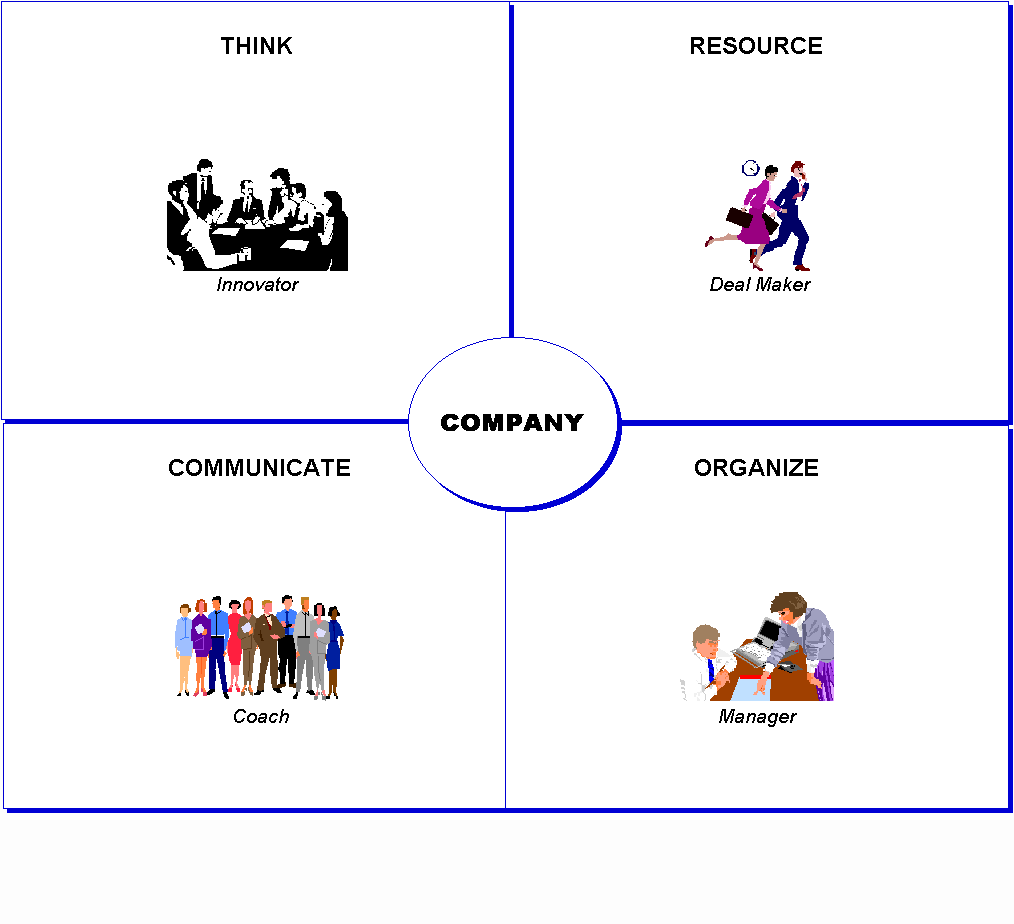
Having answered these two basic questions, four worldviews emerge that dramatically effect how people see organizations and leadership. These worldviews emphasize alternately how we: think, communicate, resource , or organize.
A worldview is a collection of beliefs, values, practices; ways of seeing and ways of thinking, a whole philosophy, or kind of shorthand, about leadership, people and organizations. All of us have worldviews that are some combination of the four presented below yet we tend to lean more or less strongly toward one of the four quadrants.
 It is important to know that worldviews are the property of particular communities of people. If we are talking about leadership, these worldviews provide the rules for the right way of leading, exemplary leadership models, values, stories of past successes, tools for solving problems, etc.
It is also important to know that these worldviews are often unexamined. We follow them without being consciously aware of what is driving our actions. Finally, organizations tend to favor some worldviews and look down on others. This results in the dominance of one way of doing things and weakness in the areas that are not favored. We believe that all four are necessary, four kinds of leading, and that a "company" is the outcome of healthy respectful contention among the four.
The quotes on the following page illustrate each of the four worldviews and the kind of leader who is likely to hold this worldview.
Four Ways of Leading
Click here to see image of how leaders fit quadrants
Leadership Worldviews Questionnaire
Scoring
Match your response to each question by putting an X through the leadership worldview that fits each response, i.e., think, communicate, resource, or organize.
For example, if your response to Question #1 was "D" put an X through the Think. Continue until you have matched all questions and responses to appropriate worldview.
|
Response Question # |
A |
B |
C |
D |
|
1 |
Organize |
Resource |
Communicate |
Think |
|
2 |
Think |
Communicate |
Resource |
Organize |
|
3 |
Think |
Organize |
Resource |
Communicate |
|
4 |
Communicate |
Resource |
Organize |
Think |
|
5 |
Think |
Communicate |
Organize |
Resource |
|
6 |
Communicate |
Resource |
Think |
Organize |
|
7 |
Communicate |
Organize |
Think |
Resource |
|
8 |
Think |
Communicate |
Resource |
Organize |
Total all answers below. Use the model on the next page to graphically display your leadership worldview
|
THINK |
|
|
COMMUNICATE |
|
|
RESOURCE |
|
|
ORGANIZE |
by putting the total number of all Xs for each worldview in the appropriate quadrant For example, if you had a score of 3 for Think, put 3 Xs in that quadrant, and 1 for Organize put I X in that quadrant, 4 for Communicate, put 4 in that quadrant, and 0 for Resource, put none in that quadrant.
Reflections:
There are several other ways of identifying leadership worldviews. If you want to explore yours further, try these methods.
Write down your 5 greatest successes as a leader. Use this format. Write a brief paragraph that describes the problem, the actions you took to address it, and the results. Partner with a peer, read them your stories and have them put Xs in the appropriate quadrants of the model whenever they hear words or phrases or actions that suggest that way of leading. Reflect on the results. Switch roles and coach your peer.
Think about the biggest challenge that you are facing right now as a leader. Make two lists. List 1 names all of the barriers and obstacles to success from your point of view. List 2 names all of the barriers and obstacles as seen by your fellow leaders. Label all of the barriers with a T (Think), C (Communicate), R (Resource), or O (Organize). Where do you tend to look? How about your teammates? Are there ways of leading that are neglected by you? Your team? Are there ways of leading that would be especially useful given this particular challenge? Are there ways of leading that are not acceptable in your group?
Again, think about the biggest challenge that you are facing right now as a leader. What is the problem; give it a name? How would others on your team name the problem?
What are the implications for being a great leader?
A successful company is created when all four ways of leading are available.
This will create necessary and healthy contention but that is the heart of creativity. The belief is that the company, or decision, will be greater than the sum of the parts.
In order to do this, you will need to develop, and help others develop
In order to do this, you will likely need to do less of the following:
Conclusion
Leadership arrives neither through magic nor inheritance. Development of leadership depends first upon awareness of the existing frameworks that you use. Then leadership requires a willingness to explore the consequence of those frameworks, and an eagerness to build capacity by testing other points of view and gaining new skills. This assessment can only address the first part of building awareness. The decisions about whether your actions and attitudes constitute the right mix for your organization at this time are left for you to make. Likewise, the actions to continue your learning in order to refine your leadership can only come about through your choices.